Fungus Gnat Biocontrols: Nature's Hit Squad
Predators, parasites, and pathogens that target fungus gnats
Biological control agents are living organisms that prey on, parasitize, or infect fungus gnats. They are especially valuable for greenhouses, nurseries, and large indoor operations that need ongoing suppression without chemical inputs. For home growers, biological controls work best when combined with BTI as part of an integrated approach.
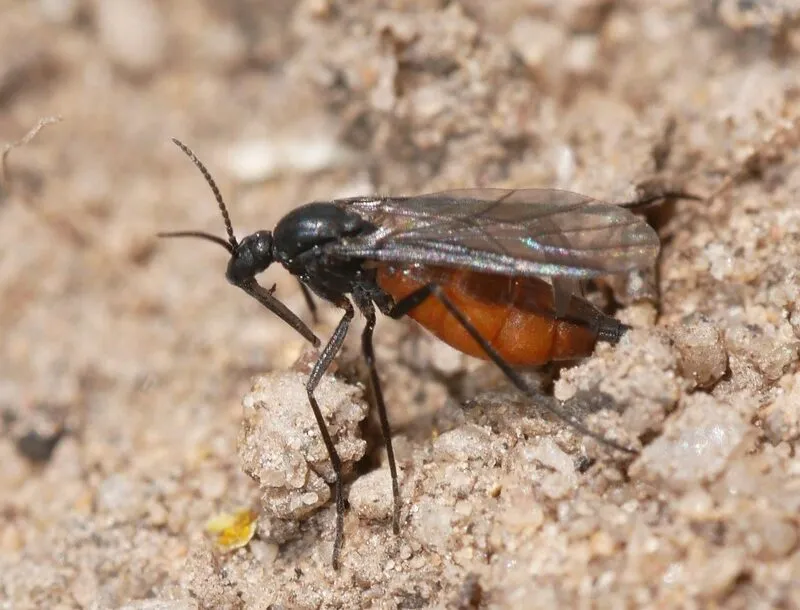
Photo: Toby / iNaturalist, CC BY
Commercially Available Agents
The three living biocontrols sold for fungus gnats in the US
Beneficial Nematodes (Steinernema feltiae)
How they work
Microscopic roundworms that seek out fungus gnat larvae in the soil. They enter larvae through body openings and release symbiotic bacteria (Xenorhabdus) whose toxin kills the larva in one to two days by blood poisoning. The nematodes multiply inside the dead host, and new juveniles leave to find fresh targets.
Application
Mix with water and apply as a soil drench on cloudy days or in the evening. Water the media before and after. Recommended media temperatures vary by source: UMass says 50–80°F with 60–70°F best, and UC IPM says 60–90°F. Nematodes stay active in the media for about 10–14 days, and repeat applications are usually needed.
Keep the soil moist. Nematodes need moisture to move through the pores of the growing media and find larvae, and they are very sensitive to drying out and UV light. This is the opposite of the usual "let it dry out" advice for gnats.
The catch. A dry top inch or two is the most widely recommended cultural control, because egg-laying females avoid it and eggs laid there fail to hatch. Nematodes need you to give that up for the weeks they are working. They are also live animals: they have to be applied at the right media temperature, kept out of sunlight, and usually reapplied. For a few houseplants that's a lot of fuss. A BTI drench is a teaspoon in a watering can, so I'd reach for it first and keep nematodes for greenhouses and big setups where the media stays moist anyway.
Buy Steinernema feltiae nematodes on Amazon →
Pros
- Particularly effective against larvae
- Multiply inside dead hosts and move on to new ones
- Compatible with rove beetles and with most pest control products except carbamate and organophosphate insecticides
Cons
- Perishable: mail-order only, apply as soon as they arrive
- Sensitive to UV light and drying out
- Results depend on rate, timing, growing media, moisture, temperature and nematode strain
- Need to go on before larval numbers build up
Predatory Mites (Stratiolaelaps scimitus)
How they work
Formerly known as Hypoaspis miles. Tiny (<1mm) tan soil-dwelling mites that feed on fungus gnat larvae, preferring young 1st instar larvae, and on the prepupal and pupal stages. They also eat thrips pupae, springtails, and shore fly larvae. They live in the top 1/2 to 1 inch of the media and do not go dormant in winter.
Application
Distribute carrier material over the media surface. Apply to moist, not wet media. UConn gives a minimum media temperature of 60°F (inactive below 59°F). Do not mix into growing media. Apply at planting time for preventive control. Life cycle from egg to adult is about 18 days at 68°F and 12 days at 75°F.
Pros
- One release can set up a population for a whole growing season
- Survive by scavenging when prey is scarce
- No diapause; active year-round
Cons
- Best used preventively before gnats establish large populations
- Do not refrigerate
- Eaten by rove beetles (Kansas State says not to use the two together)
- Probably not effective in individual houseplants, per UC IPM
Rove Beetles (Dalotia coriaria)
How they work
Small (1/8 inch), dark brown to black beetles. Generalist predators that prefer fungus gnat larvae but also eat shore flies and thrips pupae; both adults and the three larval stages live in the growing media. Adults can fly, which helps them disperse through a growing area. Once established in a greenhouse, they stay year-round. Females lay about 90 eggs and live about 48 days; males live about 60 days. Life cycle from egg to adult takes 17 days at 79°F.
Application
Release in the evening (they are nocturnal). Distribute in small piles on the media surface or use breeder bucket systems placed under benches. Optimal conditions are 65–80°F and 50–85% humidity.
Pros
- Once established, stay in the greenhouse year-round
- Compatible with nematodes
- Growers can rear them on site in breeder buckets
Cons
- Kansas State says more study is needed on how much they reduce fungus gnat numbers
- Prey on S. scimitus mites
- Hide in cracks and crevices, making them hard to find when scouting
Non-Commercially Available Natural Enemies
Hunter Flies (Coenosia attenuata)
Predatory flies that catch fungus gnats and shore flies mid-flight. They lay eggs in the growing media, and their larvae prey on gnat and shore fly larvae there. They are not sold commercially, but they do show up on sticky cards. About twice the size of shore flies, with clear, possibly iridescent wings. Females have a dark gray body with black legs; males have yellow legs.
Parasitic Wasps (Synacra spp.)
Synacra pauperi is a naturally occurring parasite of fungus gnats found in greenhouses, coming in from outdoors. Females lay eggs inside gnat larvae; the larva lives until it pupates, then dies, and one wasp comes out of each gnat pupa. About the size of a fungus gnat (1/8 inch), with pinched waists between head, thorax and abdomen and elbowed, beaded antennae.
Hexacola neoscatellae
A parasitic wasp of shore flies, not fungus gnats. UConn notes it may be present in unsprayed greenhouses and help hold down shore fly numbers, and shore flies often turn up alongside fungus gnats.
Compatibility Matrix
| Agent | + BTI | + Nematodes | + Pred. Mites | + Rove Beetles |
|---|---|---|---|---|
| BTI | — | Compatible | Compatible | Expected to be (BTI only affects fly larvae) |
| Nematodes | Compatible | — | Compatible | Compatible |
| Pred. Mites | Compatible | Compatible | — | Avoid: rove beetles eat the mites |
| Rove Beetles | Expected to be (BTI only affects fly larvae) | Compatible | Avoid: they eat the mites | — |
Tips for Using Biological Controls
- Always apply to moist (not saturated) growing media: biological agents need moisture to survive and move through the soil.
- Best used preventively or at first sign of gnats, before populations build to high levels.
- Most are perishable: use immediately upon receipt.
- Avoid broad-spectrum insecticides that will kill natural enemies along with the pests.
- Combine agents carefully: UConn suggests adding BTI or nematodes when gnats are already established and you're using predatory mites. Don't pair rove beetles with the mites.
- For home growers: BTI drenches are more practical than biological agents for individual pots; UC IPM says the mites are probably not effective in single houseplants. Save biocontrols for larger collections or persistent problems.
Sources
- Biological Control of Fungus Gnats, UConn Extension
- Stratiolaelaps scimitus: Biological Control Agent of Fungus Gnats and Western Flower Thrips (MF3632), Kansas State University Research and Extension
- Fungus Gnat Management in Greenhouses and Nurseries (MF2937), Kansas State University Research and Extension
- Managing Fungus Gnats, Thrips, Aphids and Mites, UMass Extension
- Pest Notes: Fungus Gnats, UC Statewide IPM Program
- Fungus Gnats, Colorado State University Agricultural Biology
- Parasitic wasp of fungus gnats, Synacra pauperi, UMass Extension
- Managing Shore Flies in the Greenhouse, UConn Extension
- Bti for Mosquito Control, US EPA