The Fungus Gnat Life Cycle
Why one gnat turns into hundreds in a month
Fungus gnats undergo complete metamorphosis: egg, larva (four instars), pupa, and adult. Indoors, a complete generation takes roughly 3–4 weeks, and as little as 17 days at 75°F. The warmer it is, the faster they reproduce. Multiple overlapping generations exist simultaneously, which is exactly why they are so difficult to eliminate once established.
The Numbers
- A single female lays 100–200 eggs in cracks and crevices of growing media
- Eggs are tiny: oval, white or semi-transparent
- Larvae feed in the top 1–2 inches of soil but can be found throughout the media profile, even at drainage holes
- Pupation occurs in soil, lasting 4–6 days
- Adults live only 7–10 days, so every egg is laid inside that short window
- At 75°F, a complete generation finishes in about 17 days; most extension sources give 3–4 weeks
- Reproduction can continue year-round indoors
Detailed Stage Breakdown
Eggs
Oval, smooth, white, and semi-transparent. Extremely small, barely visible to the naked eye. Females lay them in small clusters on the surface of moist soil or tucked into crevices. They prefer cracks and gaps in the growing media, where it is more humid and more eggs survive.
Eggs hatch in about 4–6 days at room temperature, a little faster when it's warm.
Larvae
Four instars (stages between each molt). White to translucent with a distinctive shiny black head capsule, legless. Feed for approximately 2 weeks at 72°F. Primary food sources include fungi, decaying organic matter, root hairs, and plant roots. Most feed in the top inch or so of soil.
Can grow up to about 5.5–6 mm long. Transparent enough that you can see food in the gut. They pupate inside a silken chamber in the soil.
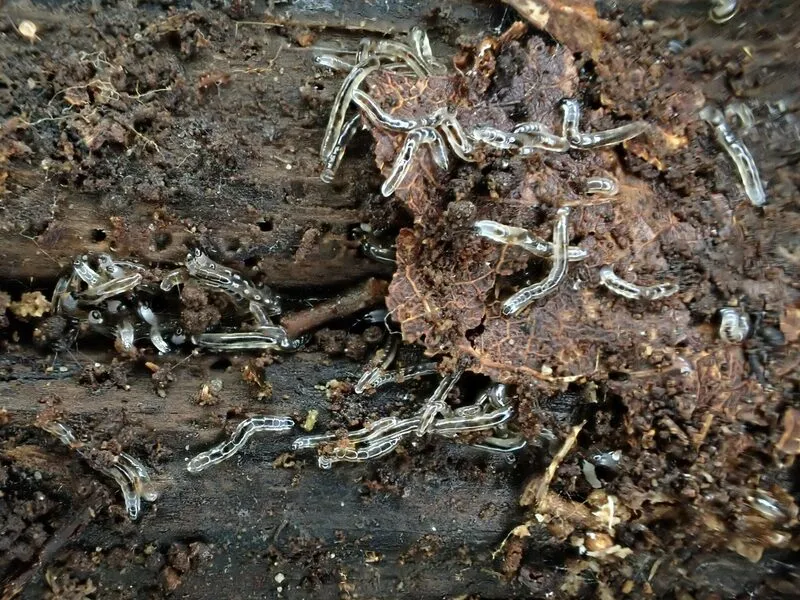
Photo: Grey Smith / iNaturalist, CC BY
Pupae
Develop in the growing media for 4–6 days. BTI only works on larvae that eat it, and a pupa is not feeding, so this stage is out of reach.
This is why you will keep seeing adults for a week or two after you have killed the larvae. Pupae already in the soil finish in 4–6 days, and the adults that come out live another 7–10 days.
Adults
3–4 mm long, grayish to black, with long legs and antennae. Weak fliers, they tend to run across soil surfaces and take short, darting flights. Drawn to light and often gather at windows.
Live about 7–10 days. Females can lay 100–200 eggs. Adults do not bite people and do little or no direct harm to plants.
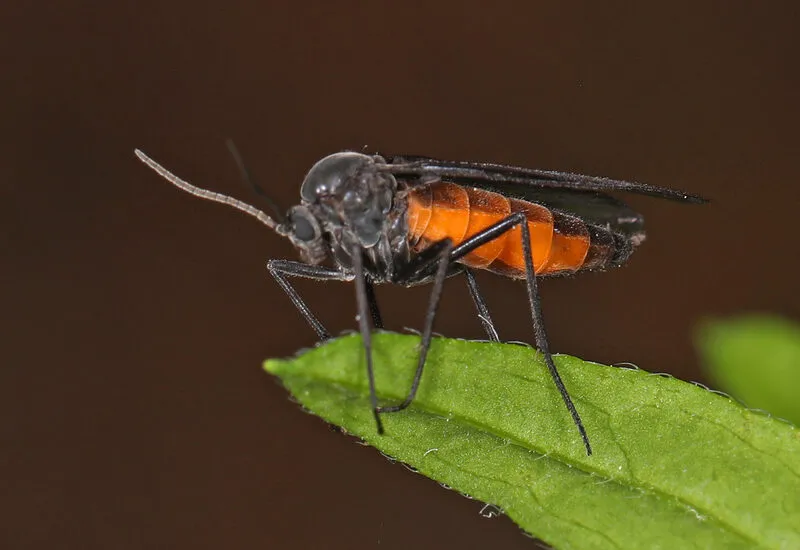
Photo: Judy Gallagher / iNaturalist, CC BY-SA
The Four Stages at a Glance
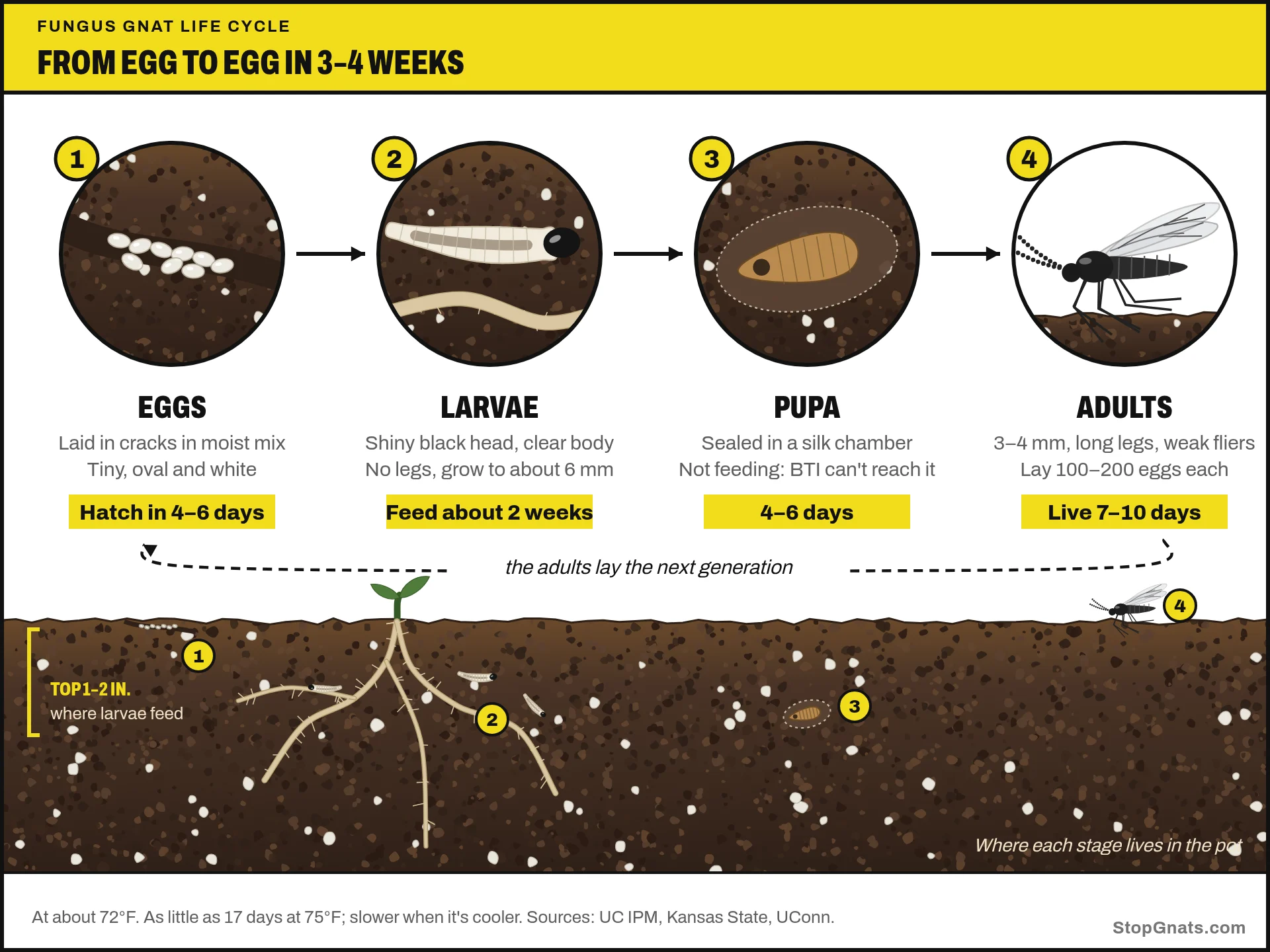
So one pregnant gnat flying in through a window is enough to start an infestation. She can lay 100 or more eggs, so one generation later, about 3–4 weeks, you can go from one gnat to a hundred. By the time you notice adults flying around, larvae are already established in the soil and the next generation's eggs are already laid. You're always fighting multiple life stages at once.
Temperature and Development Speed
Higher temperatures mean faster reproduction and more generations per year
- At 75°F (24°C): about 17 days per generation (UC IPM)
- At 77°F (25°C): 15.6 days for one lab strain of Bradysia impatiens, while another strain took about 27 days at a constant 75°F
- At 63–70°F (17–21°C): 18–23 days from egg to adult for Bradysia coprophila in an older study, and longer when cooler
- Typical indoor figure: 3–4 weeks from egg to adult
Heated homes and greenhouses allow year-round reproduction. Outdoors, it depends on the climate: in inland California they are most common in winter and spring, and in mild, moist places they can be around all year. Indoors, they never have to stop.
Sources
- Pest Notes: Fungus Gnats, UC Statewide IPM Program
- Fungus Gnat Management in Greenhouses and Nurseries (MF2937), Kansas State University Research and Extension
- Managing Fungus Gnats in the Greenhouse, UConn Extension
- Managing Fungus Gnats, Thrips, Aphids and Mites, UMass Extension
- Fungus Gnats, Colorado State University Agricultural Biology
- Darkwinged Fungus Gnats, Bradysia spp. (EENY-215), University of Florida IFAS Extension
- Small Flies (ENTFACT-657), University of Kentucky Entomology
- VectoBac WDG / Gnatrol WDG label (EPA Reg. No. 73049-56), Valent BioSciences via US EPA