Concentrated BTI Is What Kills Fungus Gnats
The one treatment that actually eliminates fungus gnats, safely
What Is BTI?
Bacillus thuringiensis subspecies israelensis (commonly abbreviated as BTI or Bti) is a naturally occurring soil bacterium. Its spores carry proteins that are toxic to the larvae of a few kinds of flies: mosquitoes, black flies, and fungus gnats.
The EPA says Bti only affects those larvae, has no toxicity to people, and has minimal toxicity to honey bees. Bt strains including israelensis were practically nontoxic to fish in testing, and Bt does not seem to hurt earthworms. That is why it works so well here: it kills the gnat larvae and leaves most everything else in the pot alone. The concentrate itself still carries a CAUTION label, so read the precautions on the bottle.
How It Works
BTI has to be eaten. When a fungus gnat larva swallows the spores and their protein crystals, this is what happens:
-
Crystal activation
The toxin only switches on in a high-pH gut (around pH 9 to 10.5), like the gut of a fly larva. -
Gut wall damage
The activated toxin binds to receptors in the gut lining and disrupts the gut wall. -
Larvae respond within a day
The Gnatrol label says fungus gnat larvae generally respond within 24 hours of a drench. -
Death within days
Larvae die over the following days from the gut damage, infection and starvation.
People and other mammals have acidic stomachs that destroy the toxin, and they lack the gut receptors it needs. That is why the EPA says Bti has no toxicity to people and it is approved for organic farming. Bt is also exempt from food residue limits because of its low toxicity.
Why Concentrated BTI Works When Dunks/Bits Don't
The Concentration Advantage
BTI works better on young 1st and 2nd instar larvae than on older 3rd and 4th instars. In an active infestation you have larvae of every age at once, so you need to hit hard and keep hitting. The product labels say the same thing: for an existing infestation, the Gnatrol label calls for three weekly drenches at the heavy rate, which is four times its light rate, and the Microbe-Life FGX directions say to reapply weekly at 2–4 teaspoons per gallon.
A liquid concentrate makes that heavy rate easy to measure. Dunks are built to release slowly into standing water, so steeping one in a watering can is a slow, uncertain way to get BTI into soil. That fits what I saw: they only held my infestations steady.
Our Recommended Product
Microbe-Life FGX (Fungus Gnat Exterminator)
Liquid BTI concentrate with fungus gnats on the label. Easy to measure with a teaspoon and mix into a watering can.
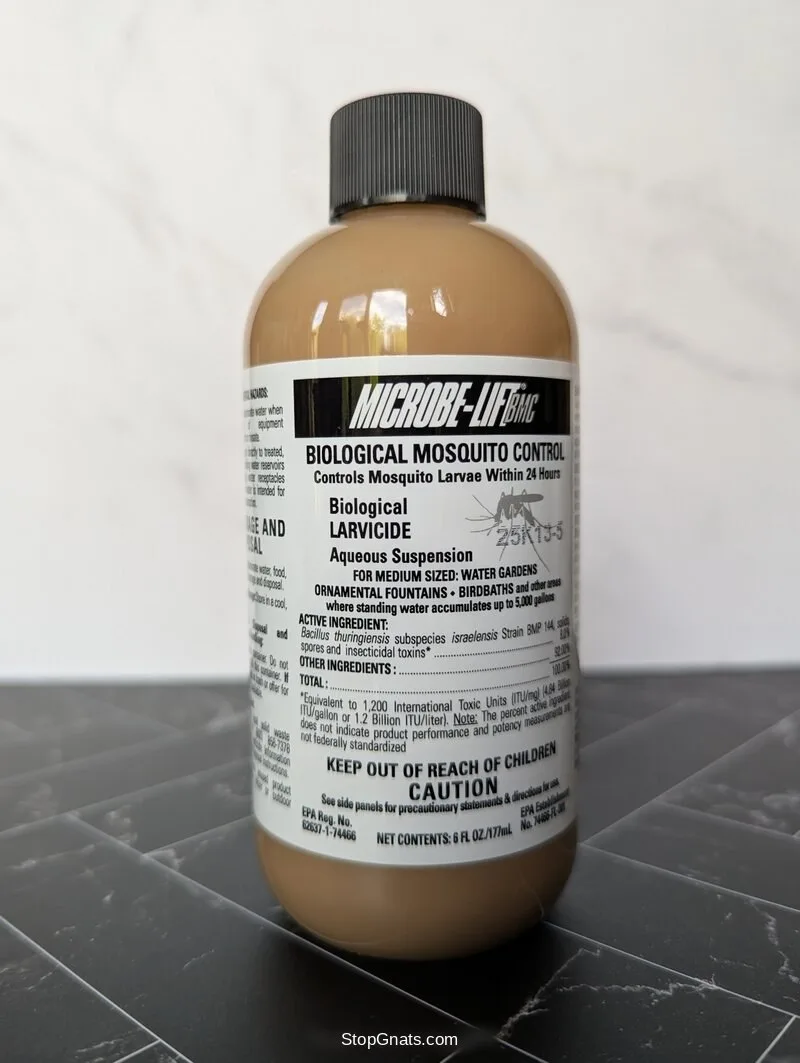
The concentrate that ended my infestations was Microbe-Lift BMC, the same maker's mosquito product. Its bottle is labeled for ponds and standing water, and the fungus gnat directions only existed on the commercial label behind it. FGX is sold under that same EPA registration (62637-1), but its own directions are written for fungus gnats, so this is the one I'd buy now.
Dose, from the FGX directions: 1/2 to 1 teaspoon per gallon for light infestations and 2 to 4 teaspoons per gallon for heavy ones, applied as a drench that wets the surface of the growing medium, and reapplied weekly while the infestation is heavy. The gallon figures above come from those rates. The directions are written for ornamentals, vegetables and herbs in greenhouse and nursery areas; read the label on your bottle and follow it.
Other Good Options
If FGX is out of stock, or you'd rather have a powder
Magic Gardener Fungus Gnat Killer. This is Gnatrol, the BTI that greenhouse growers and extension guides name, packed in a 4 oz jar for home use. It's the only one I found whose label actually says house plants and residential use. It's a powder rather than a liquid: the label says 1 to 1.5 teaspoons per gallon of water, enough to wet the soil surface. Sold by seed and garden catalogs.
Knock Out Gnats. Also Gnatrol, repacked into a 4 oz pouch under its own EPA registration by a specialty BTI seller. Same powder, same idea. Check the rate on the package you get.
Gnatrol WDG. The original, sold to commercial growers in a 16 lb pail. That's a lifetime supply unless you run a greenhouse; for a few pots, buy one of the 4 oz versions above.
Microbe-Lift BMC. What I used, and it works, but its bottle is labeled for mosquitoes in ponds and its drop-based directions are pond rates, far too weak for soil. FGX is the same registration with gnat directions, so buy that instead.
Mosquito Bits. Labeled for fungus gnats and sold everywhere, but in my pots they only held an infestation steady, and the soak-and-skim routine is a chore. See the myths page.
Other BTI Products
| Product | Form | Concentration | How You Can Buy It | Best For |
|---|---|---|---|---|
| Microbe-Life FGX | Liquid concentrate | Same registration as BMC | 8 fl oz or 1 gallon | Houseplants / hydroponics / easy measuring (labeled for fungus gnats) |
| Magic Gardener Fungus Gnat Killer | Water Dispersible Granule (Gnatrol) | 37.4% Bti | 4 oz jar from garden catalogs | Houseplants (labeled for house plants) |
| Knock Out Gnats | Water Dispersible Granule (Gnatrol) | 37.4% Bti | 4 oz pouch from a specialty seller | Houseplants / small grows |
| Gnatrol WDG | Water Dispersible Granule | 37.4% Bti | 16 lb pail from grower suppliers | Commercial greenhouses |
| Microbe-Lift BMC | Liquid concentrate | 8% Bti | Small bottles (2 oz, 6 oz) up to 1 gallon | Ponds (bottle is labeled for mosquitoes) |
| Mosquito Bits | Granules (corn cob carrier) | 2.86% Bti | Garden centers | Light prevention / maintenance (labeled for fungus gnats) |
| Mosquito Dunks | Solid ring (slow release) | 10.31% Bti, released slowly over 30+ days | Garden centers | Rain barrels / birdbaths |
Percentages are the active ingredient from each product's EPA label. The labels themselves warn that the percentage doesn't tell you how well a product performs, and potency units aren't standardized between brands, so don't compare them too literally. What matters more is how much BTI ends up in the water you pour.
What a gallon of drench costs
Bottle price says little on its own. What matters is how many gallons of drench you get out of it at the rate on the label. Prices are what I found in November 2026; they move around, so check before you buy.
| Product | Price found | Label rate, active infestation | Gallons per pack | Cost per gallon |
|---|---|---|---|---|
| Magic Gardener (4 oz jar) | $20–25 | 1–1.5 tsp per gallon | about 43–64 | about $0.30–0.60 |
| Microbe-Life FGX (8 fl oz) | $40–50 | 2–4 tsp per gallon | 12–24 | $1.70–4.20 |
| Mosquito Bits tea (8 oz tub) | $13–17 | 4 tbsp per gallon | 4 | $3.25–4.25 |
How I worked it out: FGX is 48 teaspoons per 8 oz bottle. The Mosquito Bits label says 1 tablespoon weighs 0.5 oz, so an 8 oz tub is 16 tablespoons, enough for 4 gallons of tea. Magic Gardener is sold by weight, so its teaspoon count (about 64 per jar) comes from the bulk density on the Gnatrol safety data sheet (0.36 g/mL); a heaped or packed spoon will change it. At its light rate (1/2–1 tsp per gallon) FGX costs about a quarter as much per gallon.
So the Gnatrol powder is the cheapest per gallon, and the Bits are the most expensive as well as the most hassle. For a few houseplants I still pick FGX, because a liquid is easier to measure and mix and one 8 oz bottle covers a full three-week treatment.
How to Use It So It Works
Get these right or BTI won't work
- BTI only kills larvae, not adults. You need yellow sticky traps for adults while BTI breaks the reproductive cycle.
- BTI must be ingested; it does not kill on contact.
- Keep soil consistently moist during treatment. This goes against the usual advice to let the soil dry out. My reasoning: larvae only eat BTI while they're feeding, and they feed in moist media. Water in smaller amounts more often rather than flooding the pot; the Gnatrol label also says not to follow a drench with a lot of extra water.
- Don't mix it with copper or chlorine products. The Gnatrol label warns that fertilizers or fungicides containing copper or chlorine can neutralize BTI. Normal tap water chlorine isn't expected to be a problem.
- BTI does not last long indoors. Reapply every 5–7 days. UC IPM says repeat applications about every five days may be needed.
- Apply as a soil drench, enough to wet the growing media where larvae are.
- Different subspecies from caterpillar Bt. Products labeled for caterpillars (Bt kurstaki) are not effective on fungus gnats.
- Gentle on soil life. It only targets fly larvae, and Bt does not seem to hurt earthworms.
- Edible plants: the FGX and Gnatrol directions both list vegetables (and FGX lists herbs) for fungus gnat drenches, and Bt is exempt from food residue limits. Use a product whose label covers your crop.
Sources
- Bti for Mosquito Control, US EPA
- Bacillus thuringiensis (Bt) General Fact Sheet, National Pesticide Information Center
- BMP 144 (2X) label (EPA Reg. No. 62637-1), Becker Microbial Products via US EPA
- VectoBac WDG / Gnatrol WDG label (EPA Reg. No. 73049-56), Valent BioSciences via US EPA
- Mosquito Bits label (EPA Reg. No. 6218-86), Summit Chemical via US EPA
- Mosquito Dunks label (EPA Reg. No. 6218-47), Summit Chemical via US EPA
- Fungus Gnat Management in Greenhouses and Nurseries (MF2937), Kansas State University Research and Extension
- Pest Notes: Fungus Gnats, UC Statewide IPM Program
- Fungus Gnats, Colorado State University Agricultural Biology
- Gnatrol 37.4% 16 LB WDG, Griffin Greenhouse Supplies
- Microbe-Life FGX fungus gnat directions, Ecological Laboratories (Microbe Life Hydroponics)
- Magic Gardener Fungus Gnat Killer label (EPA Reg. No. 73049-56), Valent via Fedco Seeds
- Knock Out Gnats (EPA Reg. No. 73049-56-56872), Organic BTI
- Gnatrol WDG / VectoBac WDG Safety Data Sheet, Valent BioSciences via UC Davis
- Prices checked November 2026: FGX 8 oz, Webb’s; Magic Gardener, Park Seed; Magic Gardener, Home and Garden Supply; Mosquito Bits 8 oz, Johnson’s Garden Centers