Complete Fungus Gnat Treatment Protocol
A step-by-step plan to eliminate fungus gnats for good
Your 3-Week Plan
Pick your product and how much water you mix. You get the dose, your drench days, and a card to print.
Most failed treatments I've seen come down to two things: the wrong dose, or a skipped week. BTI only kills larvae that are feeding when you drench, so it takes three drenches a week apart to catch every larva as it hatches.
Step-by-Step Elimination Protocol
-
Assess the Infestation
Place yellow sticky traps horizontally at the soil surface of every pot. Check after 48 hours. Place raw potato pieces (about 1-inch chunks, cut side down) on the soil surface to detect larvae; inspect after 2 days. Kansas State reports potato disks pulled up 38% of the larvae in the media, against 23% for carrot, and that 48 hours works better than 24. If you find larvae on the potato or more than a few adults on the traps, you have an active infestation that needs treatment.
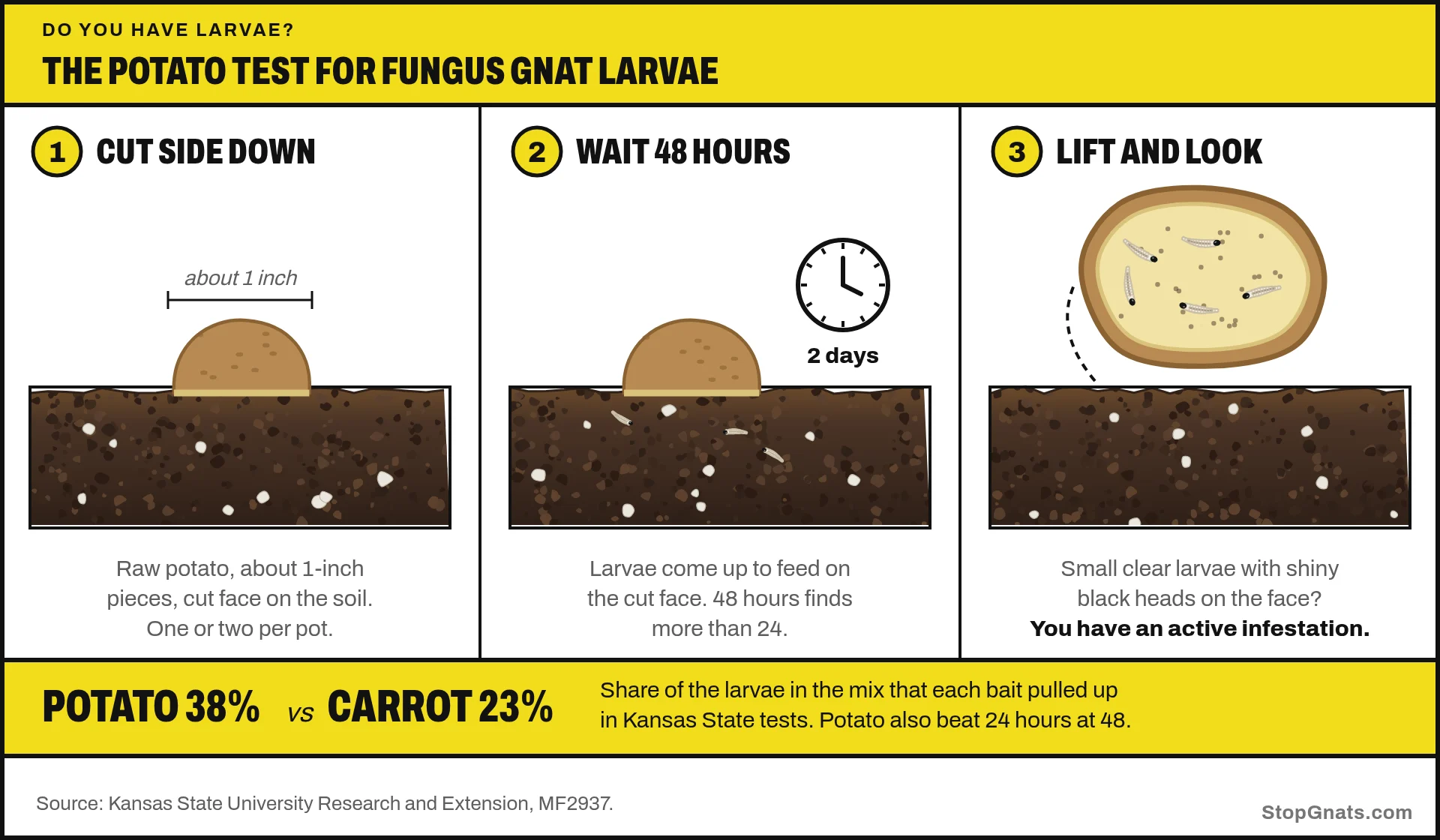
The potato test. Kansas State found potato pulled up more larvae than carrot, and 48 hours worked better than 24. -
Adjust Your Watering Strategy
This is counterintuitive: during active BTI treatment, you actually want to keep soil consistently moist, the opposite of the usual "let it dry out" advice. My reasoning: larvae only take in BTI while they're feeding, and they feed in moist media. Nematodes also need moisture to move through the mix. Instead of deep, infrequent waterings, switch to smaller volumes more frequently to keep the mix evenly moist without waterlogging it. The Gnatrol label also says not to follow a drench with a lot of extra water.
-
Apply Concentrated BTI Soil Drench
Mix concentrated BTI (Microbe-Life FGX, or a Gnatrol product such as Magic Gardener Fungus Gnat Killer) per label directions and water every pot with it, enough to wet the whole root zone. For an active infestation the labels give a heavy rate: 2 to 4 teaspoons per gallon for Microbe-Life FGX, and 1 to 1.5 teaspoons per gallon on the Magic Gardener label (13 to 26 oz per 100 gallons for Gnatrol WDG in a greenhouse). Check the directions with your product before mixing.
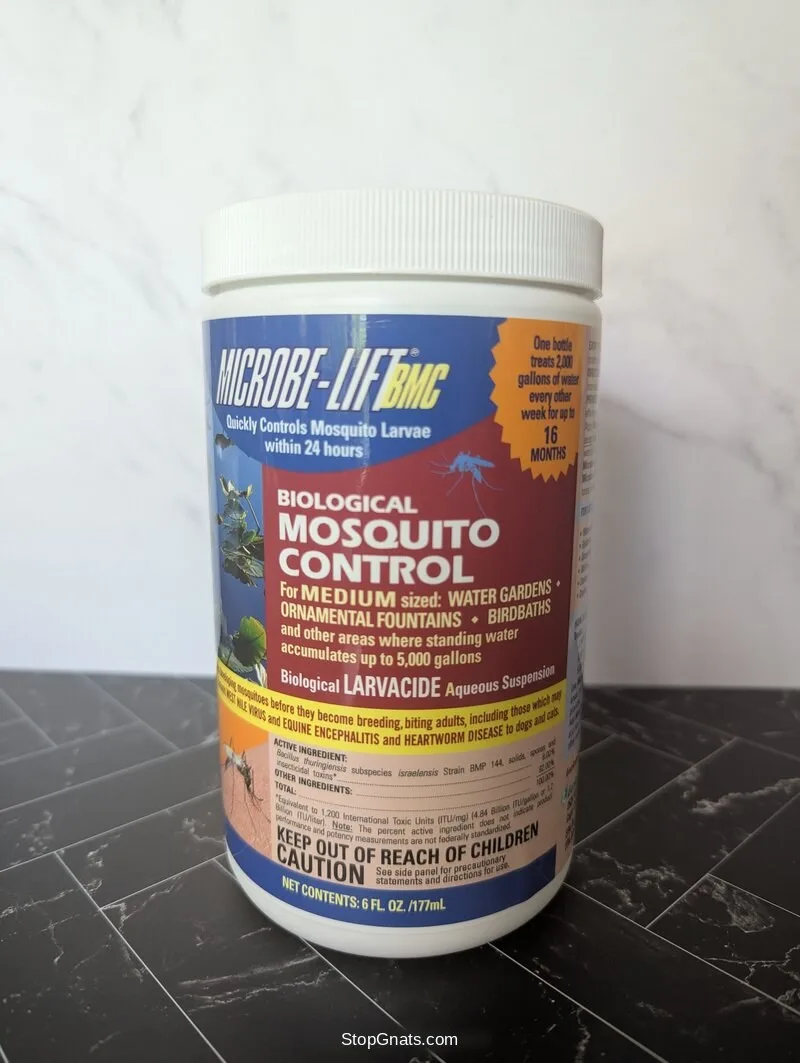
Microbe-Lift BMC, the concentrate I used. Its gnat-labeled twin is Microbe-Life FGX -
Repeat BTI Applications Every 5–7 Days
BTI does not last long indoors; UC IPM says repeat applications about every five days may be needed. Reapply every 5–7 days for at least 3 consecutive applications to catch larvae that hatch from eggs laid after the first treatment. The Gnatrol label says the same for existing infestations: three weekly applications at the heavy rate, then regular follow-ups at the light rate for maintenance.
-
Maintain Yellow Sticky Traps
Keep traps in place throughout treatment and beyond. They catch some adults before they can lay more eggs and show you whether the population is dropping. Replace when full or dusty. Extension guides say to place them horizontally at the soil surface, where the gnats are.
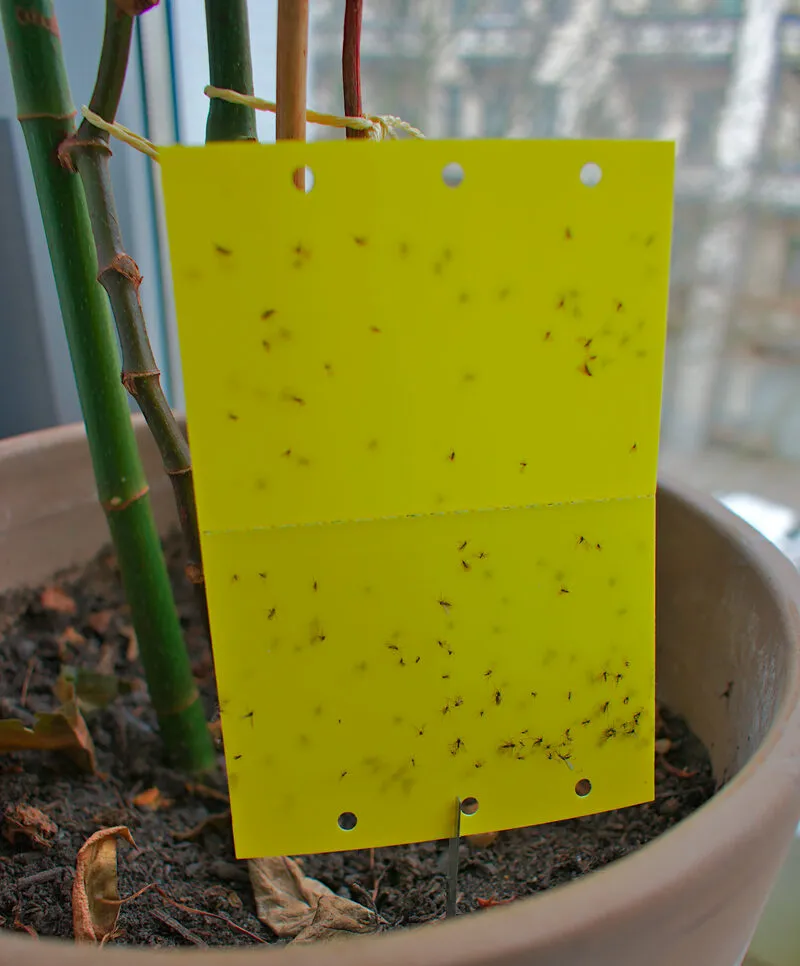
A yellow sticky trap after a few days. Each speck is a trapped adult fungus gnat. A catch like this means an active infestation. Photo: Wikimedia Commons, CC BY-SA 4.0
-
Consider Adding Biological Controls
For persistent infestations or large operations, combine BTI with beneficial nematodes (Steinernema feltiae) or predatory mites (Stratiolaelaps scimitus). These attack larvae in the soil from a different angle, and the mites can set up a population that lasts the growing season. Nematodes need moisture to move through the mix, so keep up the frequent-watering approach from Step 2. Learn more about biological controls →
-
Monitor and Maintain
After the initial 3-week treatment, switch to a preventive BTI drench at the label's light rate every 2nd or 3rd watering. Continue monitoring with sticky traps. A few gnats on a trap is normal; a sudden increase means it's time for another full treatment cycle.
Alternative and Supplemental Treatments
Hydrogen Peroxide Drench
The usual home recipe is 1 part 3% hydrogen peroxide to 4 parts water, poured through the soil. I couldn't find a university trial showing it controls fungus gnats, and extension advice is to try gentler controls first and not to use it on seedlings.
WARNING: Peroxide is a strong oxidizer that kills a lot of organisms, not just gnat larvae. I don't use it in living soil or alongside beneficial nematodes.
Neem Oil / Azadirachtin
Azadirachtin, from neem, is an insect growth regulator. Kansas State lists azadirachtin products such as Azatin XL among the insecticides labeled against fungus gnat larvae in greenhouses. Use a product whose label lists fungus gnats and follow its rate.
Horticultural Oil Spray
Petroleum horticultural oils (Kansas State lists PureSpray Green and SuffOil-X) are labeled against adult fungus gnats and work by suffocation. They do nothing to larvae in the soil, but fewer adults means fewer eggs.
Treatment Timeline
-
Day 1
Apply first BTI drench to every pot. Place yellow sticky traps horizontally at soil level.
-
Day 2–3
Larvae begin dying; the Gnatrol label says larvae generally respond within 24 hours. No visible reduction in adults yet; pupae formed before treatment are still hatching.
-
Week 1
In my pots, this is when the traps start catching fewer new adults. Apply second BTI drench.
-
Week 2
Much less gnat activity. Apply third BTI drench. Most adults you still see came from pupae that were already in the soil, or hatched before the larvae died.
-
Week 3–4
This is where my infestations ended, as long as every pot was treated every time. Check with a potato piece; if there are no larvae, switch to the maintenance schedule.
-
Ongoing
Preventive BTI drench with every 2nd or 3rd watering. Monitor sticky traps weekly. Replace traps as needed.
Sources
- Fungus Gnat Management in Greenhouses and Nurseries (MF2937), Kansas State University Research and Extension
- Managing Fungus Gnats in the Greenhouse, UConn Extension
- Managing Fungus Gnats, Thrips, Aphids and Mites, UMass Extension
- Pest Notes: Fungus Gnats, UC Statewide IPM Program
- VectoBac WDG / Gnatrol WDG label (EPA Reg. No. 73049-56), Valent BioSciences via US EPA
- BMP 144 (2X) label (EPA Reg. No. 62637-1), Becker Microbial Products via US EPA
- Stratiolaelaps scimitus: Biological Control Agent of Fungus Gnats and Western Flower Thrips (MF3632), Kansas State University Research and Extension
- Hydrogen peroxide for fungus gnats, Ask Extension
- Microbe-Life FGX fungus gnat directions, Ecological Laboratories (Microbe Life Hydroponics)
- Magic Gardener Fungus Gnat Killer label (EPA Reg. No. 73049-56), Valent via Fedco Seeds
- Mosquito Bits label (EPA Reg. No. 6218-86), Summit Chemical via US EPA